

Heathrow, 20:00 Wednesday.
A couple of days up country in Spain and back to the UK. Heathrow is a modern marvel, by the time I’ve walked about a mile from the aircraft and relieved my aching bladder my bags are waiting for me. Idling around the conveyor alone.
Apart from listening to a string of actually quite useful presentations I’ve mostly been eating and drinking.
Every corporate event I’ve ever been to has the most epic volumes of food, as if having a rumbling stomach will reduce the delegates focus. Personally I find the exact opposite. Comfortably sated I relax into a torpor and daydream. Mostly about boats. Having various views of Mary Alice as my laptop screensaver doesn’t help either.
This week’s dreams are about reefing pennants, in particular if and how it would be possible to keep the third reef permanently reeved. The main problem is the sheer amount of rope required to go from boom to reef and back. There is no way of adding a tackle to this piece of rope that will contain enough movement to complete this tightening action.
Here is a drawing of the current setup with the first reef indicated only…
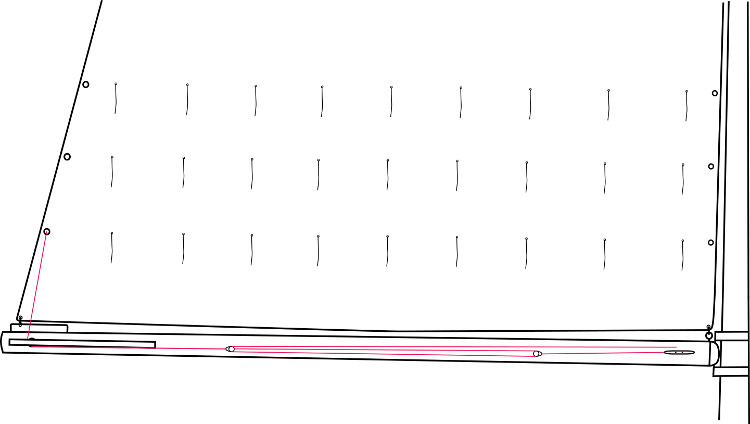
The tackle is two blocks, one with a becket and the other suspended off the cleat via a short length of line.
Here is the setup reefed…

The pennant has to pull down twice the length of rope from boom end to reef point as it goes up the far side of the sail and back down to the bee block (or piece of wood with sheave in it that turns the rope along the boom). So with a 3:1 tackle, and a 2:1 as normal from boom to sail and back, the force generated by the system can be quite substantial, although a lot of friction is generated at the cringle (metal eye) in the sail.
I really don’t want to use a winch on the boom, so am thinking a releasable tackle to be used on the reefing line with a rolling hitch. Will see what options I have as tightening a correct rolling hitch in ‘ third reef’ conditions on the top of the cabin roof at night probably won’t be much fun. But arguably more fun than trying to reeve it all through the reef point in the same conditions.
Some fresh Acton Town air is the only thing to get on the train at this stop. The platform is deserted.
Why no winches at the mast?
Well for one, cost. Before I started this venture I had a browse though some chandlery catalogues to temper my enthusiasm. That they did effectively. Your average winch suitable for planting to the mast or boom and looking OK would set you back roughly 3 tackles. Given it only gets used every now and again, return on investment is pitiful. A block and tackle is super cheap and simple to use and maintain in comparison, but does have its disadvantages. They are heavier than winches when you need three. And there is miles of rope everywhere. All the time.
Oh and I need three, so almost equal on cost.
Here is a drawing of a concept to simplify the reefing lines…
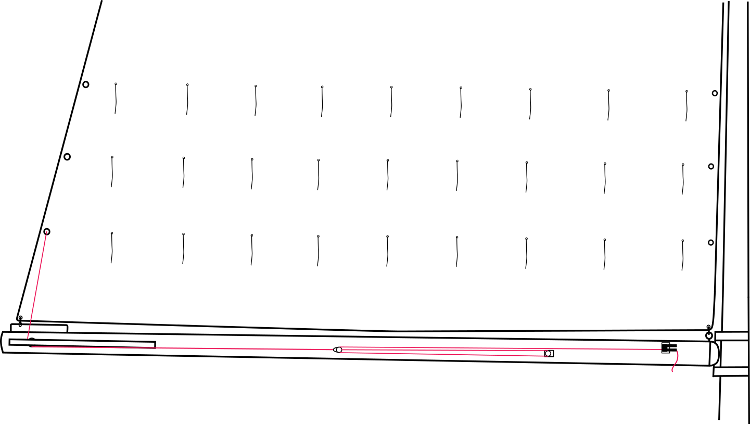
Instead of a block swinging in the breeze attached to the cleat, i’m thinking of using a double cheek block on the boom, and a small jammer to keep the reefing lines organised.
Here is a drawing of the one side of the boom setup completed with two pennants on one side, imagine the same again, but only one, on the other side.

This particular problem will have to wait until we sail Mary Alice and find out how often that third reef will be needed. She has 6 tonnes of lead in her keel so should be quite stiff. I suspect sail balance will be the reason we reef early with the third if we ever have to use it. I’m hoping that it is through choice, not necessity. But remembering the 7 ‘P’s, it’s better to be prepared.
Hammersmith, and a few more seats vacate. Also my phone’s battery is suffering a similar fate. Reefing line blog posts will have to wait. However the thoughts continue.