
New deck

Mary Alice has a minor deck problem. The survey showed some fairly large areas where the GRP sheath had been cracked, water had got in, and the plywood started to go soft. Ordinarily I think a local repair would have sufficed, however the plywood used was not marine ply and consequently I think doing a number of minor repairs would be false economy in the long run given the difficulty of making sure all rot was removed.
Instead she is getting a whole new deck and coach roof.
The plus side is that she has a fairly simple deck and coach roof shape. The downside is that taking off all the existing materials will take a long time which equals lots of labour.
The current GRP sheath is polyester resin and chopped strand mat. These two items are not really suitable for sheathing plywood. The polyester has a low adherence to plywood, and the CSM has a low strength and poor surface finish, therefor the strength of the deck comes from the plywood under a poorly bonded layer of GRP and added to this, polyester is brittle, so given this perfect storm of conditions it isn’t surprising that the GRP cracked at points of land (the bitts for example) and let in the elements.
To renew the deck I’ve asked for two layers of ply screwed and glued to the deck beams, with joints staggered and not on the deck beams. Then sheathed in tri axial cloth all stuck together (including between the two ply layers) with epoxy resin.
The epoxy has a much higher peel strength than the polyester and the triaxial cloth will provide some strength along the directions of the fibres, rather than just depth and marginal strength that the CSM does.
The other advantage is that the finish on a cloth is so much better than with CSM. If a peel ply is used to cover the finished laminate a much reduced finishing time is required.
The final finish will most likely be paint, but we’ve toyed with the idea of fake teak, real teak and everything in between. A final decision hasn’t been made yet though!


2 hours on the tube thinking about reefing lines

Heathrow, 20:00 Wednesday.
A couple of days up country in Spain and back to the UK. Heathrow is a modern marvel, by the time I’ve walked about a mile from the aircraft and relieved my aching bladder my bags are waiting for me. Idling around the conveyor alone.
Apart from listening to a string of actually quite useful presentations I’ve mostly been eating and drinking.
Every corporate event I’ve ever been to has the most epic volumes of food, as if having a rumbling stomach will reduce the delegates focus. Personally I find the exact opposite. Comfortably sated I relax into a torpor and daydream. Mostly about boats. Having various views of Mary Alice as my laptop screensaver doesn’t help either.
This week’s dreams are about reefing pennants, in particular if and how it would be possible to keep the third reef permanently reeved.  The main problem is the sheer amount of rope required to go from boom to reef and back. There is no way of adding a tackle to this piece of rope that will contain enough movement to complete this tightening action.

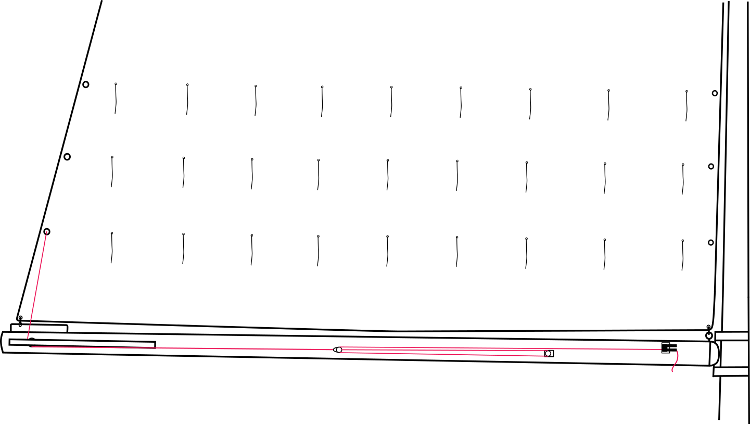
Here is a drawing of the current setup with the first reef indicated only…

reefing lines

The tackle is two blocks, one with a becket and the other suspended off the cleat via a short length of line.

Here is the setup reefed…

reefing lines reefed

The pennant has to pull down twice the length of rope from boom end to reef point as it goes up the far side of the sail and back down to the bee block (or piece of wood with sheave in it that turns the rope along the boom). So with a 3:1 tackle, and a 2:1 as normal from boom to sail and back, the force generated by the system can be quite substantial, although a lot of friction is generated at the cringle (metal eye) in the sail.
I really don’t want to use a winch on the boom, so am thinking a releasable tackle to be used on the reefing line with a rolling hitch. Will see what options I have as tightening a correct rolling hitch in ‘ third reef’ conditions on the top of the cabin roof at night probably won’t be much fun. But arguably more fun than trying to reeve it all through the reef point in the same conditions.

Some fresh Acton Town air is the only thing to get on the train at this stop. The platform is deserted.

Why no winches at the mast?
Well for one, cost. Before I started this venture I had a browse though some chandlery catalogues to temper my enthusiasm. That they did effectively. Your average winch suitable for planting to the mast or boom and looking OK would set you back roughly 3 tackles. Given it only gets used every now and again, return on investment is pitiful. A block and tackle is super cheap and simple to use and maintain in comparison, but does have its disadvantages. They are heavier than winches when you need three. And there is miles of rope everywhere. All the time.
Oh and I need three, so almost equal on cost.

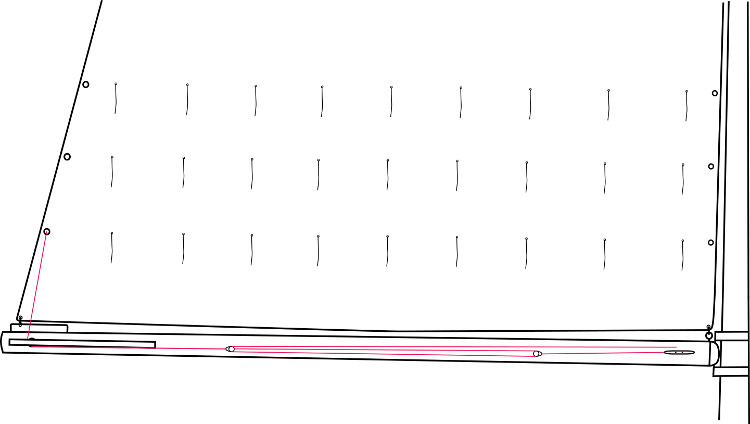
Here is a drawing of a concept to simplify the reefing lines…

reefing lines new version

Instead of a block swinging in the breeze attached to the cleat, i’m thinking of using a double cheek block on the boom, and a small jammer to keep the reefing lines organised.

Here is a drawing of the one side of the boom setup completed with two pennants on one side, imagine the same again, but only one, on the other side.

reefing lines reefed new version

This particular problem will have to wait until we sail Mary Alice and find out how often that third reef will be needed. She has 6 tonnes of lead in her keel so should be quite stiff. I suspect sail balance will be the reason we reef early with the third if we ever have to use it. I’m hoping that it is through choice, not necessity. But remembering the 7 ‘P’s, it’s better to be prepared.

Hammersmith, and a few more seats vacate. Also my phone’s battery is suffering a similar fate. Reefing line blog posts will have to wait. However the thoughts continue.


Opening Time

So we bought a boat.

There is a back story here, but frankly its not all that interesting. Essentially my wife and I are getting bored of working. I am employed by MegaCorp™ (names changed to protect the innocent) and my wife is a teacher at the older end of the school system.

MegaCorp™ has been a good employer, but its time to hand in the corporate badge for a while and do something that is not either slouching at my desk, alternating between conference call and Excel or traveling to another industrial building, in another industrial park, in another part of Europe.

Hence the boat, and a vague plan, cooked up one warm summers evening to quit our jobs and go sailing for a year. The idea is to hang on in there at MegaCorp™ and school long enough to earn some more cash, get used to the boat this year (and do some tweaking) then set off in early 2017 up the west coast of the UK.

We originally had big ideas involving sunshine and cocktails, but really, where better to spend a year than the Great British Coastline. (well ok – the Med, the Caribbean, etc etc, but I know, they take a long time to get to, and well, they get kinda busy)

So we now own a Heard 35. Not the usual cruising vessel of choice, but why not? She’s heavy, probably not that fast comparatively, harder to rig and sail, and requires more work than a typical white plastic yacht. However we’re doing this for a break, not to go around with our hair on fire.
And I have a thing for gaffers. I just don’t like varnishing and caulking. So she’s a GRP hull, plywood and GRP deck and cabin roof, and thoroughly modern below. With electric lights and everything.
No hot water though (yet).

As MegaCorp is still paying for my services, we intend to add these creature comforts slowly as we understand what we need. So the plan is a few Channel/Scilly/South coast based trips this year to figure out what’s important to us and what we can live without, then the main event next year.